by Zeenita Patra, Women on Wings Project Manager
Three key takeaways
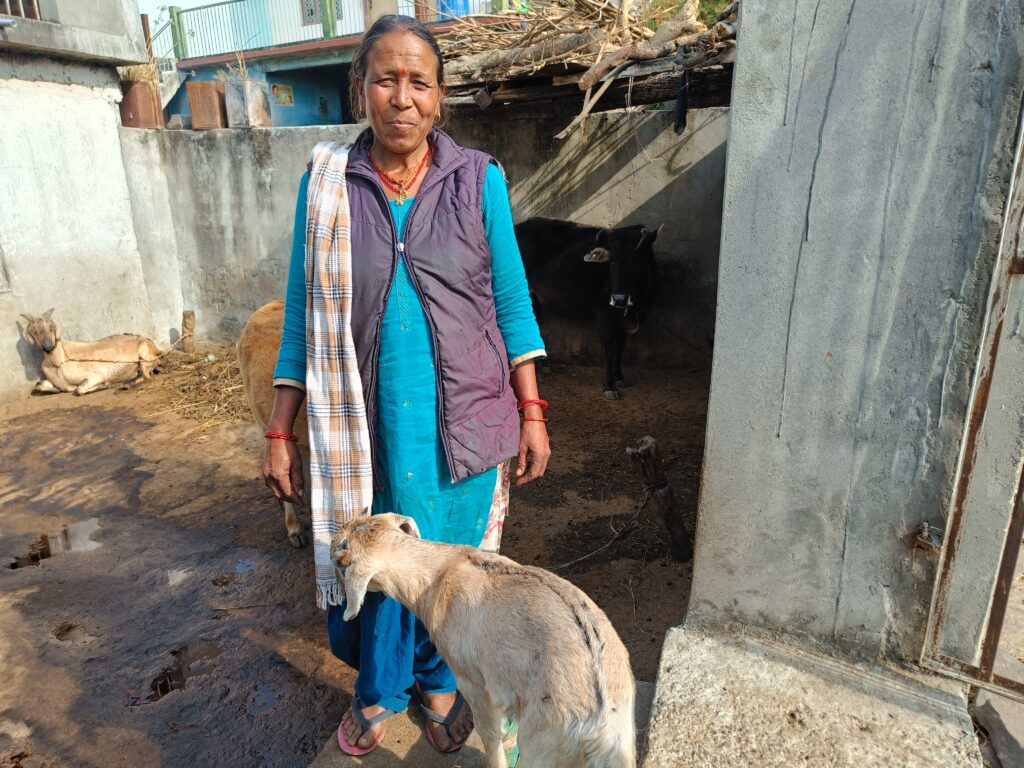
- Laxmi Devi is a farmer from Tehri Garhwal, Uttarakhand, who successfully transitioned from subsistence farming to becoming an income-earning community leader of a Cluster Level Federation of over 400 women
- She achieved this as part of a women-led collective under the National Rural Livelihood Mission (NRLM)
- Her story exemplifies the role of structured support, collective participation, and crucially, market access, in creating sustainable livelihoods for women in rural India
To reach Laxmi Devi’s village of Chilpar, you follow the Ganga river upward from the valley, winding through the rocky terrain of Tehri Garhwal in Uttarakhand. Here, the sun is bright. The mountain air is crisp. And the terraced farms and challenging narrow, windy roads along steep mountain edges weave life into the landscape, creating a constant hurdle for transportation and community connectivity.
For Laxmi Devi (50 years), life used to be a quiet, daily grind of subsistence farming and household chores. Like many women in rural India, her days were spent on agriculture, specifically for her it was cultivation of pulses, root vegetables and managing livestock, producing enough for her family, with only a small surplus sold to local traders. It was not easy to find reliable buyers.
The boundaries of her village confined her world. She was limited to her small circle, lacked networking beyond, and limited savings meant that any emergency could force her to turn to local moneylenders, increasing her debt and dependency. The uncertainty was a constant source of disquiet.
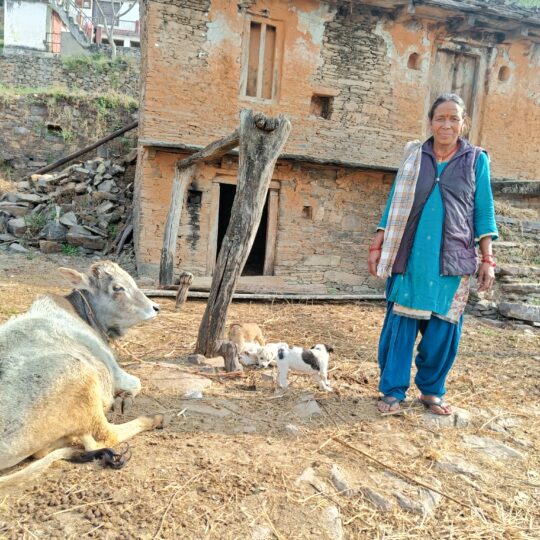
Farmer Laxmi Devi stands by livestock in the Uttarakhand Himalayas.
Today, a lot has changed. Laxmi Devi is not only a successful farmer but also a respected community leader, president of the Cluster Level Federation (CLF) she is a member of, and an ASHA didi (sister) at her village level. Her transformation is a direct result of her commitment to women’s collectives.
These collectives are an initiative of the National Rural Livelihood Mission (NRLM), which is linked to Uttarakhand’s State Rural Livelihood Mission (USRLM). A key partner agency, UGVS-REAP (rural entrepreneur accelerator), works toward rural development, focusing on community mobilization and business development. Women on Wings collaborates with UGVS-REAP, offering business consultancy to support their livelihood brand, House of Himalayas (HoH).
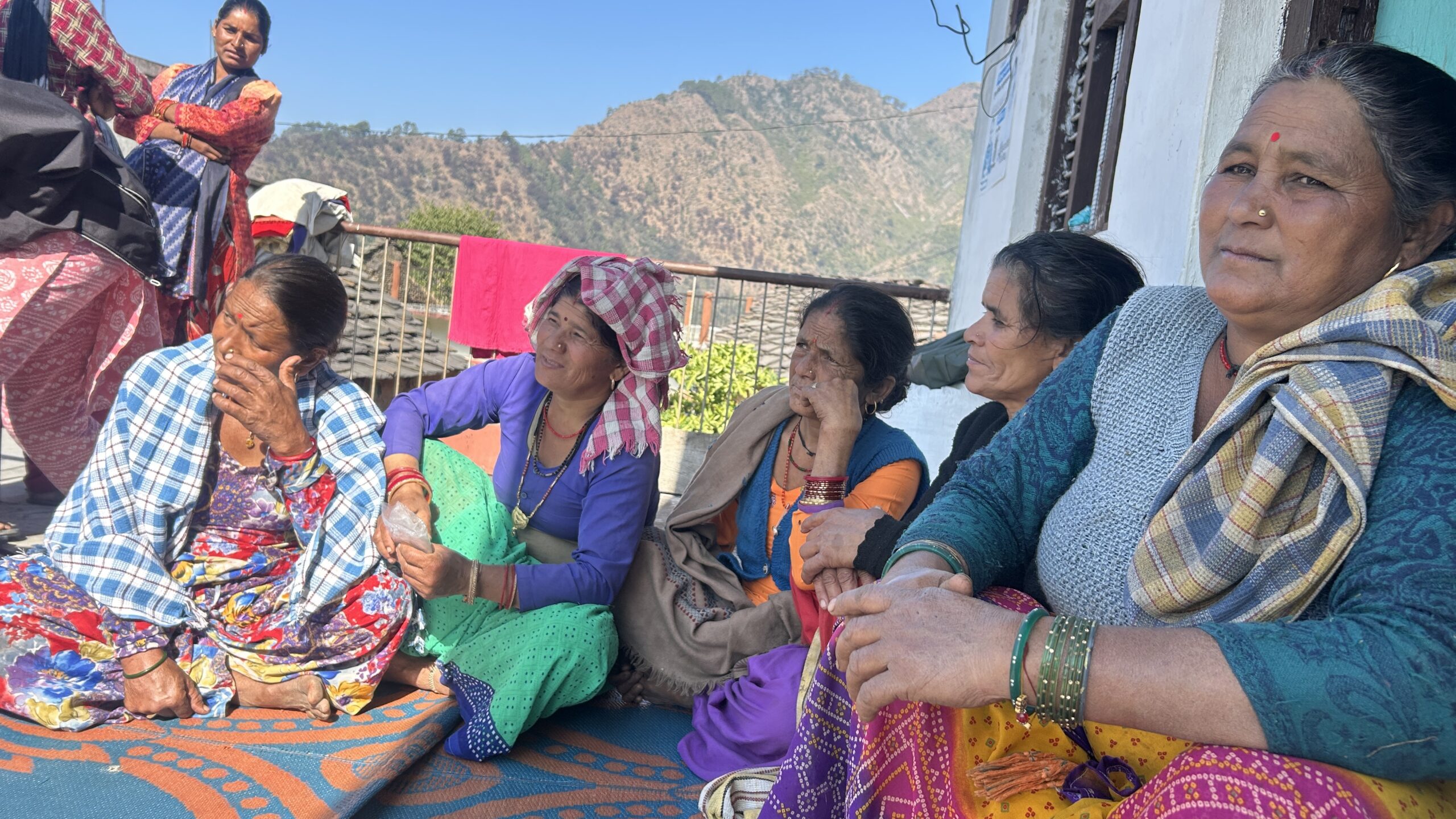
Members in Laxmi Devi’s women-led collective
The catalyst: women finding strength in numbers
The turning point for Laxmi Devi came when the NRLM programs reached her village, introducing the concept of community building and forming of Self-Help Groups (SHGs) and Village Organizations (VOs).
At first, the community felt deep skepticism around the concept. But with time, transparency and trust earned acceptability. Laxmi Devi became a committed member at her SHG and VO, and today, she serves as a vital bridge in her community. As an experienced leader in her CLF, she mentors new women, sharing how being a part of a collective can be empowering and unlocks opportunities.
The women in these collectives produced high-quality, locally authentic, and naturally farmed crops, making them ideal partners for sourcing for the House of Himalayas (HoH). Farming in her region is no easy feat, due to the wildlife crop-raiding habits, requiring farmers to take measures against damage and loss. Yet, through the CLF, pulses farmed by Laxmi Devi, like the highly sought-after Pahadi Rajma, Gahat dal, and Kali dal, gained a direct path to a professional, premium market.
These efforts span the Tehri district, where over 3,000 women are members across six CLFs, with more than 200 women actively involved in supplying six types of products to HoH. This includes those from Laxmi Devi’s CLF (which involves 478 members across 10 VOs) having supplied around four Tons of produce last year.
Laxmi Devi
Farmer, who supplies to our partner House of Himalayas
“This season, I was able to sell seven kilos of rajma (kidney beans) to HoH, with an increase of 12 rupees per kilogram compared to last year. While my personal income is modest, this reliability is everything.”
The power of a guaranteed market for women in rural areas: how was market uncertainty overcome?
The desire to see her collective thrive and overcome the challenge of finding reliable buyers for their surplus produce drew Laxmi Devi to the partnership with HoH. Before HoH, women often struggled with market access. There was no central system to connect them with potential customers, both due to their remote location and the small scale of their produce, leaving them dependent on local traders who dictated prices
Now, the system favors the women, as HoH purchases produce at rates that are slightly higher than those offered by local traders, a price point that is both profitable for and acceptable to the women. And HoH provides a unique guarantee: women are free to sell their crops in the open market if they can secure a better price, but if they struggle to find a fair buyer, HoH steps in to purchase their entire stock at a respectable rate. This system ensures that no woman is forced to sell her hard work for a pittance just to make a living.
“Beyond financial gain, the most meaningful change has been the birth of a collective mindset,” Laxmi Devi shares. “In the past, every woman worked in isolation, but now, we think and plan as one.”
Laxmi Devi has supplied to HoH through her collective for the past two seasons.
“This season, I was able to sell seven kilos of rajma (kidney beans) to HoH, with an increase of 12 rupees per kilogram compared to last year. While my personal income is modest, this reliability is everything,” she says. Her involvement with collectives over the last 10 to 15 years has strengthened her financial position through consistent earnings and savings.
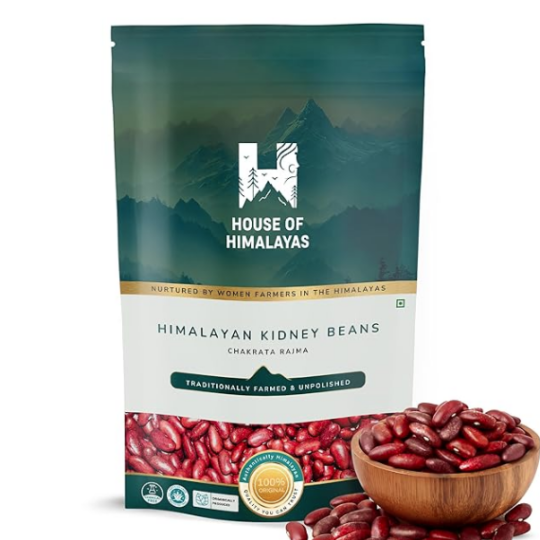
Laxmi supplies Himalayan kidney beans to the House of Himalayas that markets this premium product.
How has economic support shaped her family’s aspirations?
The impact of this stable income and collective support ripples far beyond the farm. Laxmi Devi, a mother of five, is now the family’s financial manager. Even her husband, who manages their small village shop, entrusts his earnings to her.
Most significantly, she spoke on how the economic empowerment helped. “Being able to fund their degrees and pay bills is about fulfilling a lifelong vision for my family’s future.” Her son completed a hotel management degree, and a daughter currently pursues a nursing degree.
Laxmi Devi
Farmer, who supplies to our partner House of Himalayas
“I pushed myself to adapt new skills to take up responsibility for a new job and have found my identity.”
A new identity and expanded influence
And her commitment extends beyond her household. As a community health worker (ASHA representative), she is the vital link between her fellow villagers and the public health system. Her confidence and ability to navigate complex public systems, skills she honed as a leader in the CLF, recently helped her to advocate care for a critically hospitalized villager and his pregnant wife, an act that earned her formal commendations.
For Laxmi Devi, the journey has defined her character. “I pushed myself to adapt new skills to take up responsibility for a new job and have found my identity,” she says with pride. She has moved beyond the village borders to build networks and operate in a new and formal environment such as the House of Himalayas. By removing the need to haggle with middlemen or go far and beyond to fetch higher prices for her produce, she has gained the freedom to focus on her family and her community.
Women on Wings plays a role in strengthening Indian rural enterprise models like House of Himalayas by providing pro bono business consulting across strategy, sales, branding, and supply chain. Supporting these sorts of initiatives, we create space for:
- rural products to reach premium markets
- women to receive better prices for produce
- collectives to become sustainable businesses
- women to unleash their full potential
We have been working toward our goal of co-creating one million jobs for women in rural India. As of 2025-2026 we have surpassed the half million mark. Notably 35% of these jobs happened from 2023-2026. We plan to continue accelerating the number of jobs co-created.